A golf simulator used to mean a projector and a net in a garage. Done properly, it is one of the best rooms in a house: a place to play Pebble Beach before dinner, practice with tour-grade data in January, or hand the kids a club on a rainy afternoon. The difference between a gimmick and a room a family actually uses is in how it is designed and built: the launch monitor, the screen, the picture, the software, the room, and the way it all turns on. Here is the whole thing, end to end, and how we put it together.
The Launch MonitorThe Brain
Everything starts with the launch monitor, because it is what makes the game feel real. It reads ball and club data, speed, spin, launch angle, club path, and the better it reads, the more the simulator behaves like the course. The one we reach for most often is the ProTee VX, an overhead camera system that captures full club and ball data, mounts above the player so it fits real rooms, and handles right- and left-handers without moving anything. Around it sit Uneekor’s overhead cameras, SkyTrak+ and Garmin at the accessible end for a tighter space or a first build, and Trackman at the top, the tour reference players ask for by name.
The type drives the room. Camera systems read the club and ball at impact; radar tracks the flight. Which one suits you is a conversation about your bay rather than about which brand is best. Whichever we choose, placement and calibration matter as much as the model. A monitor that is a few degrees off quietly tells comfortable lies, and dialing it in is part of the install, not an afterthought.
The Screen and EnclosureWhere the Ball Stops
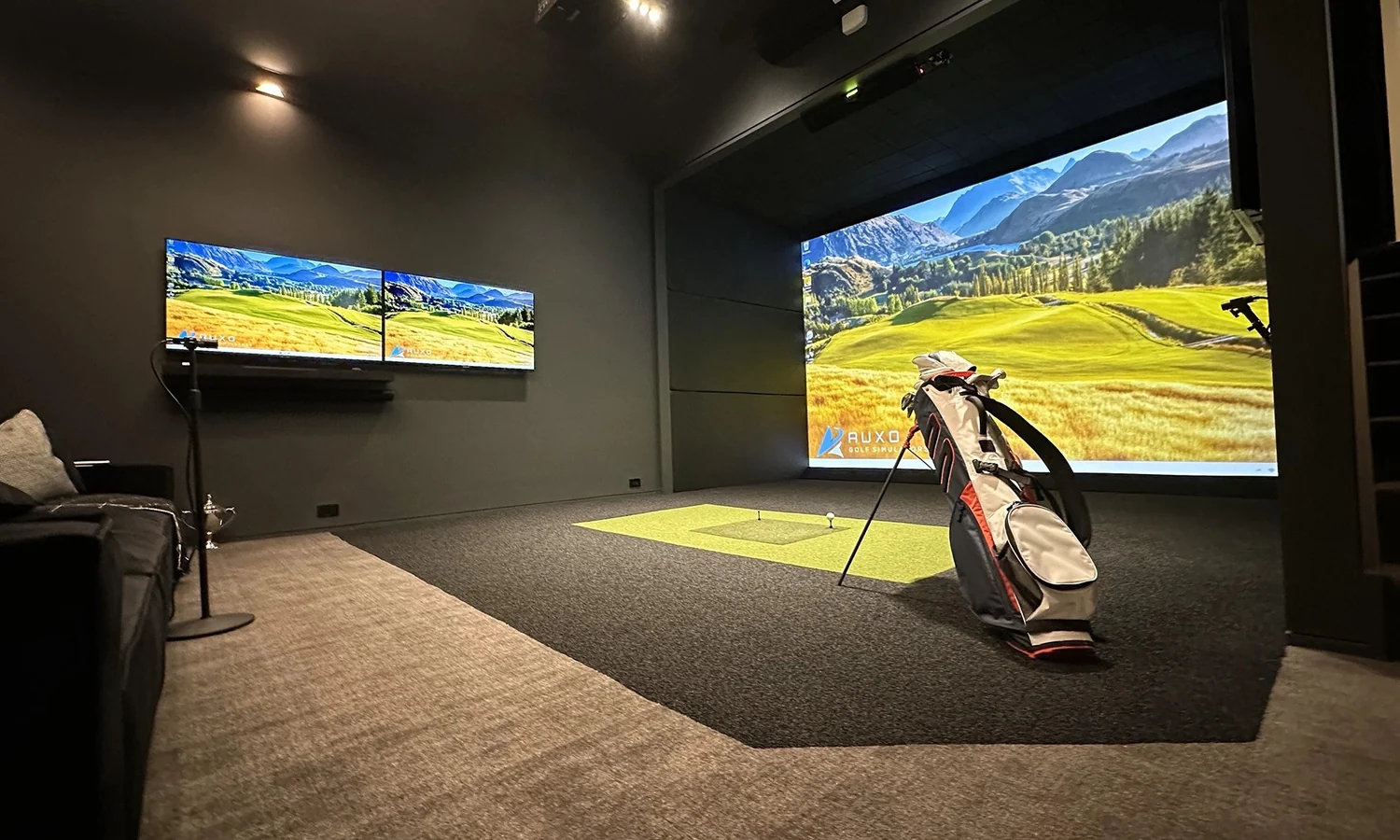
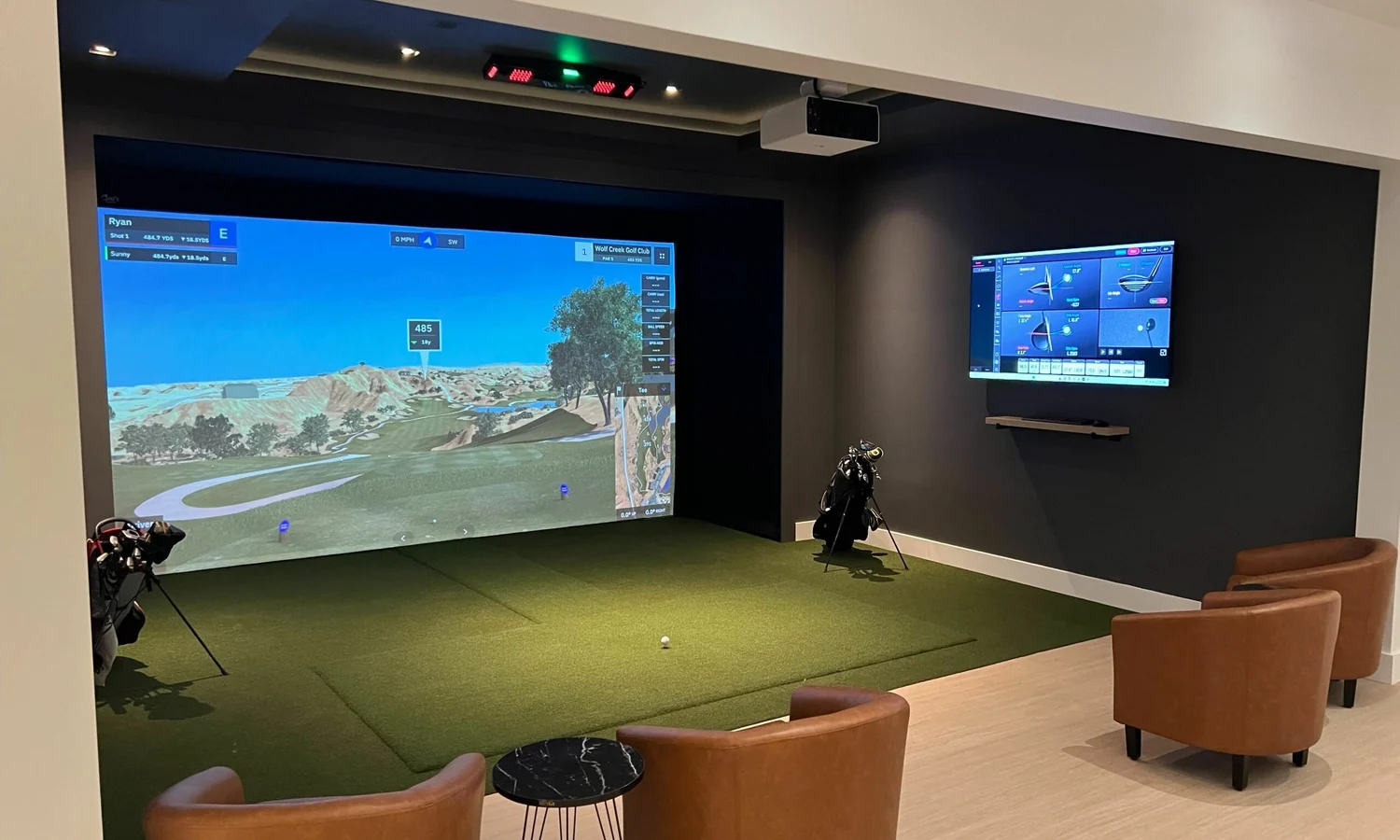
A driver swing sends a ball into the screen at well over a hundred miles an hour, so the enclosure is not an accessory. It is the safety system and the finished face of the room at once. We build around SIGPRO enclosures: a steel frame, a tensioned impact screen that doubles as the display and takes the hit without rippling, and side and ceiling baffles that catch anything offline. Done right it looks like a built-in, a clean, dark surround that frames the picture and hides the structure, rather than a cage bolted to the wall.
The PictureProjector and Screen, Matched
The image comes from a short-throw projector mounted overhead, where it will never be struck. It throws a big, bright picture onto the impact screen from close range with no shadow from the golfer, and a good one has the brightness to stay vivid with the room’s lights up. The projector and the screen are chosen as a pair, because the screen’s weave, tension and distance decide how much of the projector’s resolution you actually see. An impact screen is a consumable that has to survive several thousand hits while still holding an image, so we treat its replacement as part of the plan rather than a surprise.
The SoftwareThe Courses and the Game
The software is what turns data into a round. Platforms like GSPro, E6 Connect and TGC put hundreds of real courses on the screen, Pebble, St Andrews, the ones clients have always wanted to play, alongside driving-range practice, closest-to-the-pin games and online play against friends anywhere. It is also where the simulator earns its keep as a practice tool, logging every shot so a player can genuinely get better over a winter. We set the software up to match the launch monitor and the way the family wants to use the room, from serious practice to a Saturday-night party.
Most of the disappointment in this category is dimensional, not technical. We measure the room before we promise anything.— Blue Note A/V
The RoomSpace, Turf and Comfort
The room itself makes or breaks the experience, and it is where planning pays off. Ceiling height is the least forgiving dimension: about ten feet for a full driver swing, more if the player is tall or swings upright, with room for the overhead monitor and the projector. Width wants fourteen to sixteen feet so both right- and left-handers have a clean follow-through, and depth depends on the launch monitor you choose. Beyond the numbers, we handle the things that make it feel finished: a proper hitting mat and surrounding turf, a floor that is level and easy on the joints, acoustic treatment so impacts do not echo through the house, climate control, and comfortable seating for the people waiting their turn.
The ExperienceOne Button, Lights Down
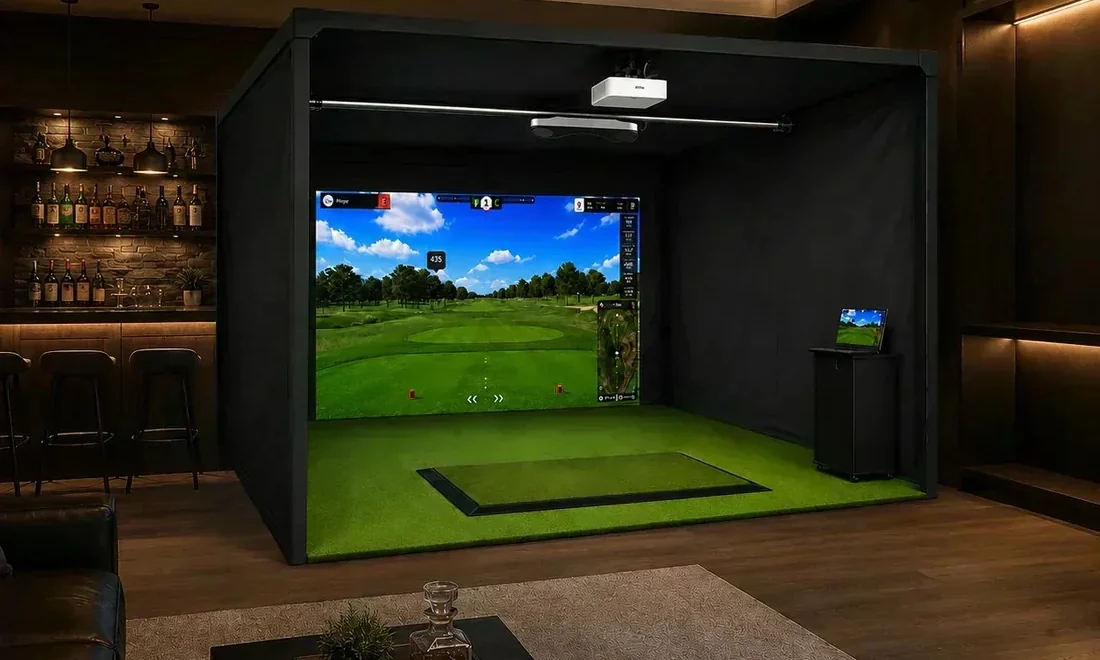
What separates a bay we build from a pile of equipment is how it behaves. One button, on a keypad or a phone, should wake the projector, launch the software, dim the lights to a playing scene, drop the shades and bring up the sound, and another should shut it all down when the last round is done. Because it is wired into the whole-house system, the big game can be on while people wait their turn. We build it as a purpose-built bay rather than a theater that also plays golf, because a room asked to do both ends up mediocre at each. The fact that it simply turns on and works is what makes it a room people use every week.
At a GlanceThe Bay, Piece by Piece
| Piece | What It Does | What We Specify |
|---|---|---|
| Launch monitor | Reads club and ball; makes the game real | ProTee VX overhead; Uneekor, SkyTrak+, Garmin, Trackman by room and player |
| Enclosure and screen | Stops the ball, carries the picture | SIGPRO frame, tensioned impact screen, baffles, built-in finish |
| Projector | The picture, from where it cannot be hit | Short-throw, bright enough for lights up, matched to the screen |
| Software | Courses, practice, games, online play | GSPro, E6 Connect or TGC, set up for the monitor |
| The room | Height, width, depth, turf, acoustics, seating | Measured and confirmed before anything is promised |
| Control | One button on, one button off | Keypad or phone; lights, shades, sound, projector on one scene |
The Real WorldWhere It Belongs, and Who It Is For
A simulator can go almost anywhere with the height for it: a bonus room over the garage, a finished basement, a converted garage bay, or a dedicated structure, and part of our job is finding the right space. It suits the golfer who wants to play and practice year-round, the family that wants a rainy-day room everyone uses, and the host who wants something no one else on the street has. It is a real project, not a kit, and it rewards being planned properly from the start. When it is, it becomes the room the whole house gravitates to.
Why build it with us
- The room is measured and confirmed before equipment is promised
- Launch monitor matched to the bay and the player, then calibrated
- Enclosure finished as a built-in, not a cage
- Projector and screen chosen as a pair
- One button on, one button off, from the house system
Things to know
- About ten feet of ceiling is the hard constraint
- The impact screen is a consumable; plan its replacement
- A purpose-built bay, not a theater that also plays golf
The room the whole house gravitates to
A simulator is six decisions that have to agree with each other: monitor, enclosure, projector, software, room and control. Get the room right first and the rest falls into place. Get it wrong and no launch monitor will save it.
Best for: Golfers who want to play and practice year-round, and families who want one room everyone uses.
Measure the bay with us
Send the room dimensions, or a photo of the space you have in mind. We will tell you what it will support before anything is promised.
Start the Conversation