
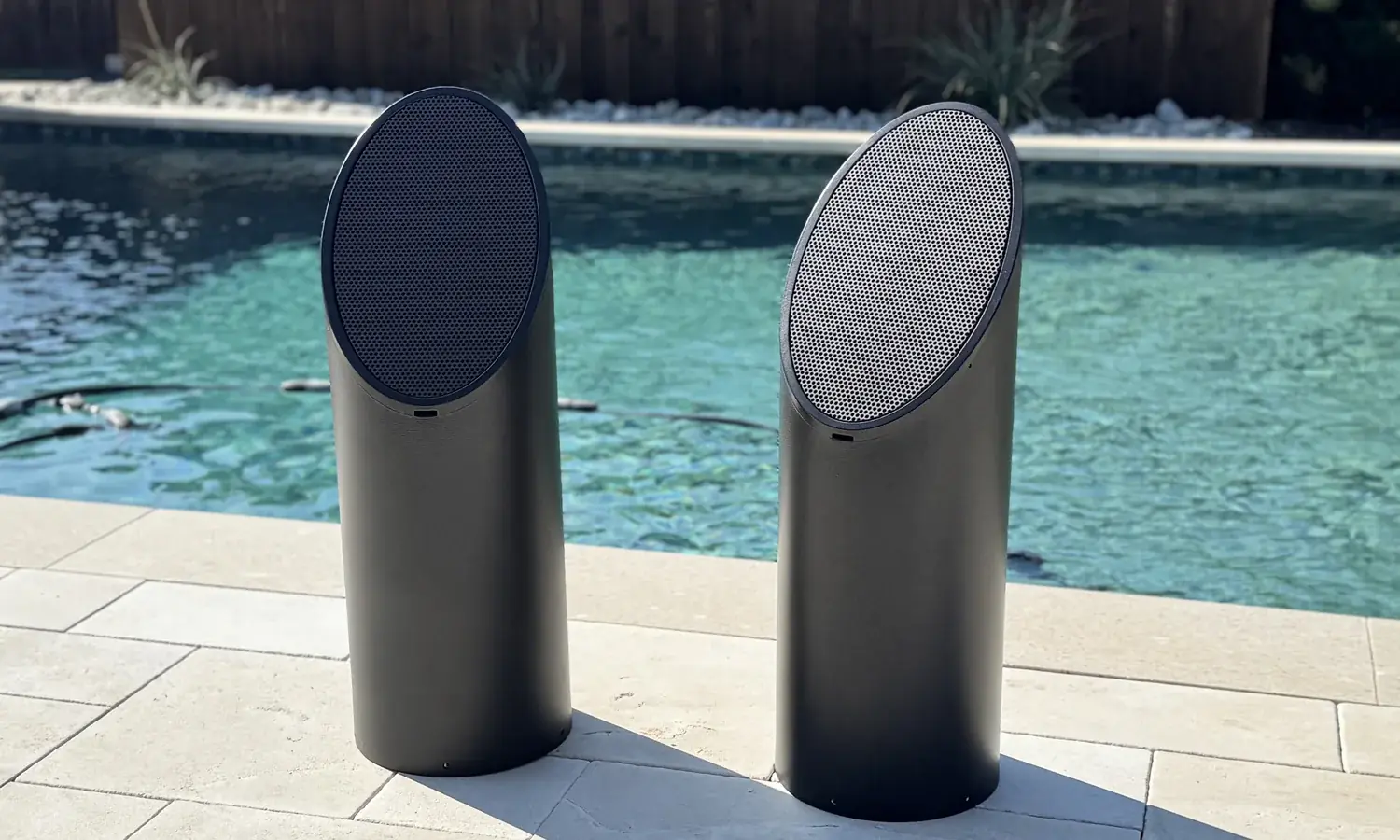
Most outdoor speakers are indoor speakers in a plastic box. Coastal Source started from the other end. The D'Ascanio family built the company in the Florida Keys, where humidity, salt and sun destroy anything that is not designed to live outside, and every product they make begins with that problem. The result is a landscape audio and lighting line that we install more than any other outside, and the reason is not the sound alone. It is that five summers later, it still works.
The ConnectorWhere Outdoor Systems Actually Fail
Ask anyone who services outdoor audio what breaks, and the answer is never the speaker. It is the splice: a wire nut and a shrink tube buried in wet soil, corroding quietly until one channel drops out in July. Coastal Source's answer is a patented connector system. Every speaker, fixture and cable in the line ends in the same plug; you push two together, twist, and the joint is air- and watertight. No cutting, no soldering, no field waterproofing. The cable itself is marine-grade tinned copper rated IP68.
It sounds like a small thing. It is the whole thing. It is why we can put a system in the ground and tell a client, honestly, that we expect it to outlast the landscaping around it.
Nobody has ever called us about a Coastal Source speaker that stopped working. They call about the sprinkler guy who cut a cable, and the fix is a plug.— Blue Note A/V
Ellipse BollardsMany Small Speakers, Close to You
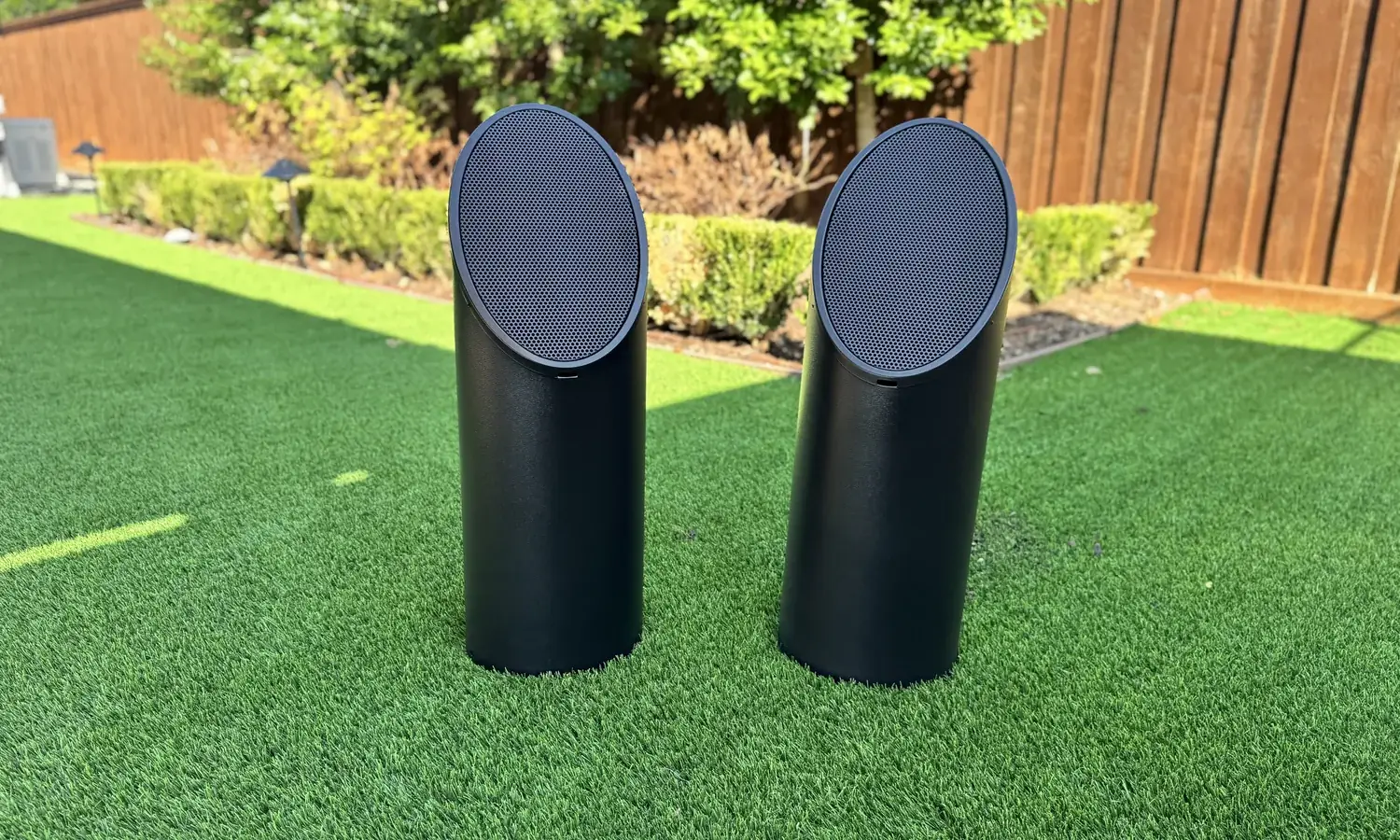
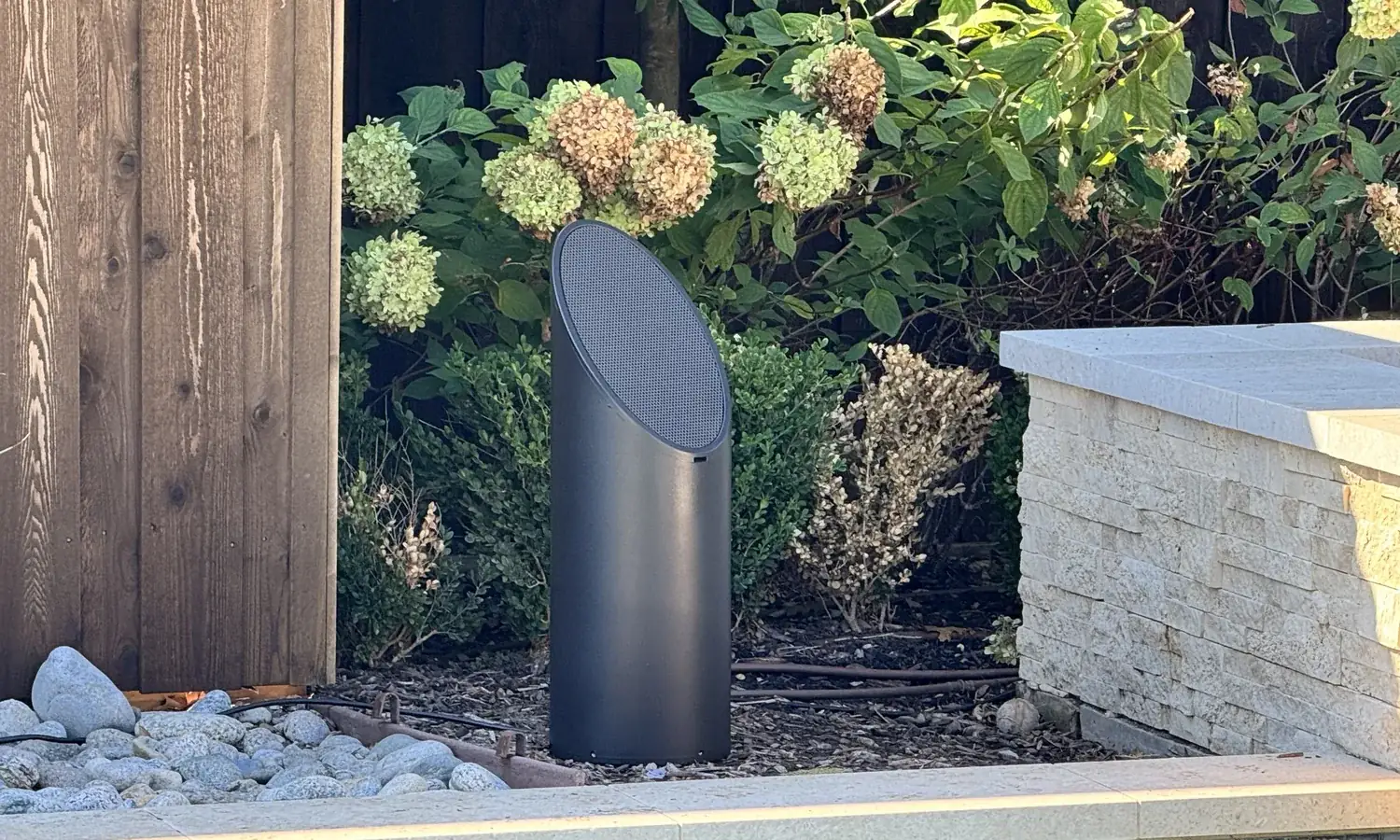
The Ellipse bollard is the speaker in most of our outdoor photographs: a cylinder with an angled elliptical face, in 8-inch and 10-inch sizes, direct-buried, freestanding or set into hardscape. The two-way versions carry a satellite and a mid-bass driver in one post; the three-way versions add a subwoofer in the base, rated to 400 watts, so one bollard can be a complete speaker. Composite cones with Santoprene surrounds, the material chosen because it does not care about UV or heat.
The way we use them is the way landscape audio should work: many speakers at low level, spread through the beds close to where people sit, rather than two loud boxes on the back wall. Coverage is even, the volume at the table is higher than the volume at the fence, and nobody is shouting over the music.
Bass and the RestSubwoofers, Razors, Line Source
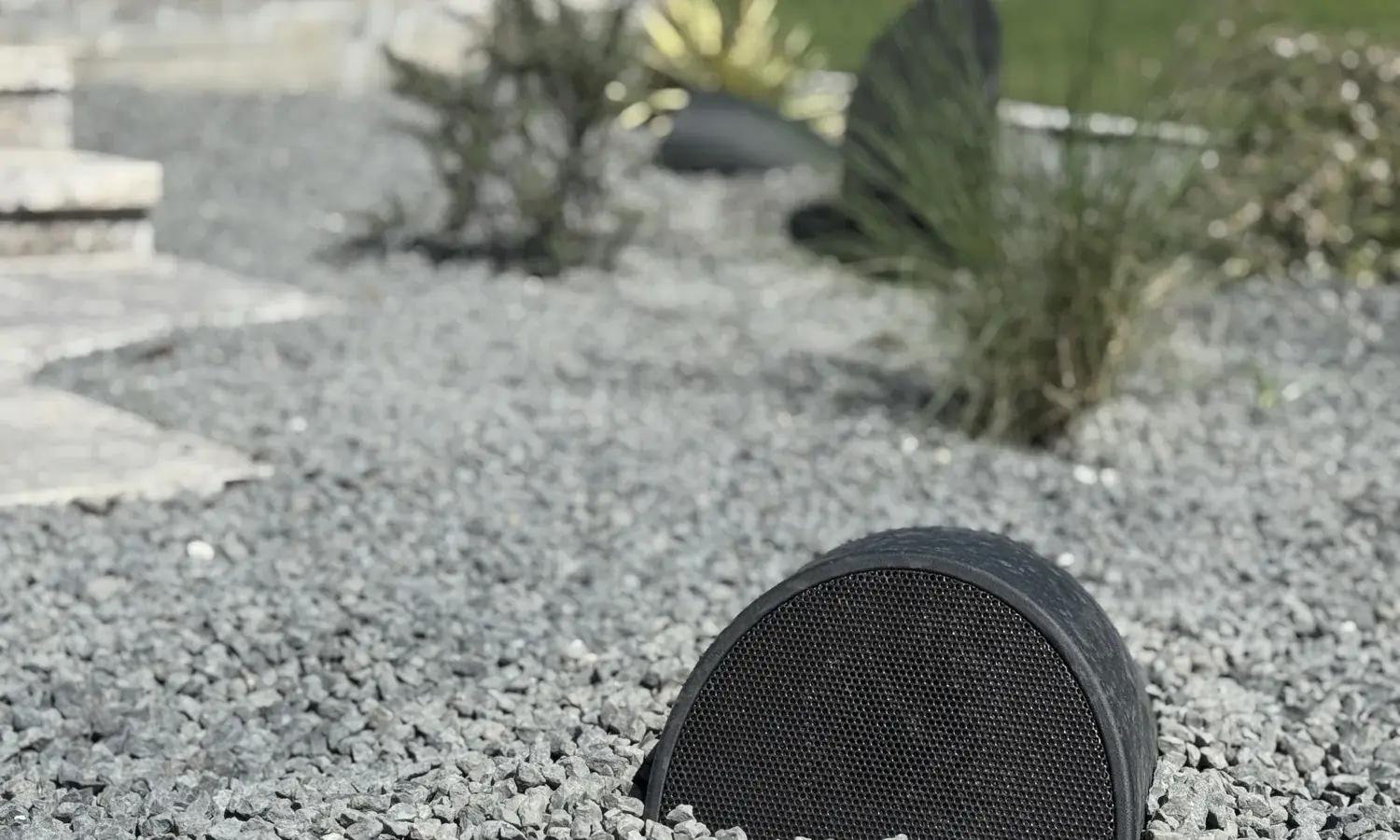
For bass, Coastal Source buries it. The Bollard Subwoofer sits in-grade with only its top showing; the bandpass version takes 300 watts and disappears into a bed. For a patio that wants a visible piece, the Cube subwoofer is a rotomolded composite block with a granite top that reads as furniture. Above ground, the Razor on-wall speakers cover the covered patio and the outdoor kitchen — the RZ300 is bi-amplified with a 400-watt subwoofer built in — and the 12.0 Line Source bollard is the one for a big lawn, throwing sound a long way without getting loud up close.
Driving it all: Coastal Source's own DSP outdoor amplifiers, in 300- and 600-watt versions with a Sonos Port input ready to go, or a rack amplifier for the large property. The DSP is tuned for the speakers, which is the part a generic amplifier gets wrong.
Landscape LightingThe Other Half of the Line
The same connector, the same philosophy, in light. Coastal Source fixtures are solid cast brass, which weathers to a patina rather than to failure, with Cree LED sources and a family of path lights, uplights for the trees and the facade, and downlights for the soft wash from above. Because the lighting and the audio share a cabling system, one trench and one plan serves both, and the fixtures land on the same astronomic schedule as the lights inside the house through Lutron or Control4.
At a GlanceThe Coastal Source Line as We Install It
| Line | What It Is | Where It Belongs |
|---|---|---|
| Ellipse Bollards 8.0 / 10.0 | Two- and three-way landscape speakers, direct-buried or freestanding | The beds, spaced close to the seating |
| Bollard and Cube subwoofers | In-grade bandpass bass; a granite-topped cube for the patio | Underground, or dressed as furniture |
| Razor RZ100 / 200 / 300 | On-wall speakers, up to bi-amplified with built-in sub | Covered patios and outdoor kitchens |
| 12.0 Line Source | Long-throw bollard | Big lawns and long pool decks |
| SAS DSP amplifiers | 300 and 600 watts, Sonos Port ready | The rack, tuned to the speakers |
| Lighting | Cast-brass path, up and down lights, Cree LED | Trees, paths, facade, on the house schedule |
The Real WorldWho It's For
Coastal Source is for the client who has already replaced one outdoor system and does not intend to replace another. It costs more than the box-store alternative, and the difference is in the parts you cannot see: the connector, the cable, the brass. It is the right choice when the yard is finished and nobody wants it dug up again, and it is the line we specify on every Outdoor Living project unless there is a reason not to. Like any landscape system, it lives or dies on layout — the count and placement of the bollards matters more than the model — which is where we come in.
Why Coastal Source
- Built in the Keys for salt, sun and humidity
- The connector: twist-shut, watertight, no field splicing
- Bass you bury and never see
- Audio and lighting on one cabling system
- Cast brass that weathers instead of failing
Things to know
- Premium pricing; the value is in longevity
- Sold and installed through dealers only
- Layout is the design; buy the plan, not just the speakers
The outdoor line we would put in our own yards
Plenty of speakers sound good on the patio in May. Coastal Source is engineered for the August that follows and the ten Augusts after that, and it sounds like a proper hi-fi system while it does it. It is the foundation of how we do outdoor audio and lighting, and the reason we can guarantee the result.
Best for: Finished landscapes, pool decks and covered patios where the system has to work for years without anyone thinking about it.
Plan the yard with us
Bring the landscape plan, or a photo of the back of the house. We will tell you how many bollards, where the bass goes, and what it will sound like at the table.
Start the Conversation