
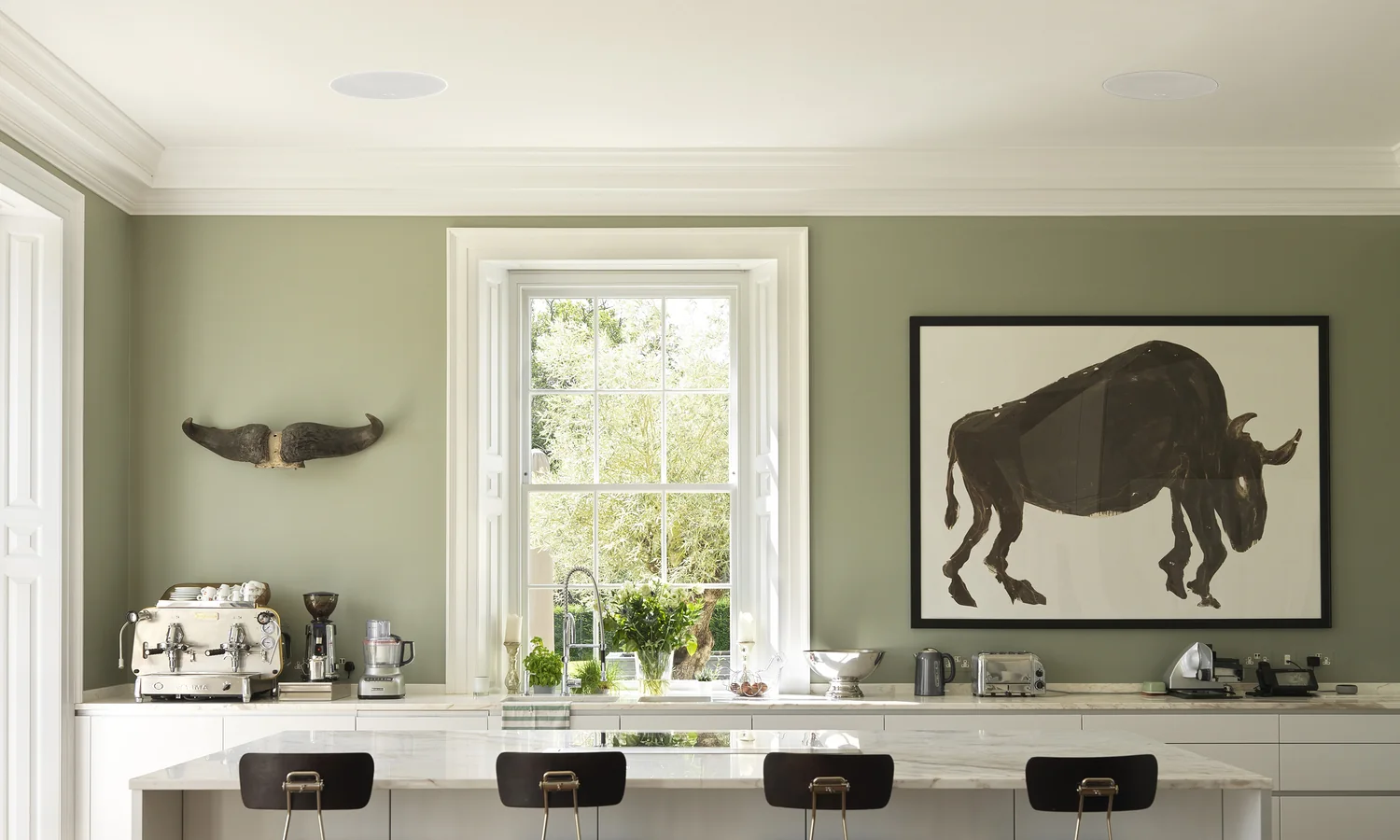
Most speaker companies have a sound. KEF has an idea. Since the 1980s the company has put the tweeter in the exact center of the midrange cone, so that every frequency leaves the speaker from the same point in space. They call it Uni-Q. What it means in a house is that the sweet spot stops being a spot: the kitchen sounds right from the sink and from the table, the media room sounds right from the couch and from the doorway. That one idea is why KEF runs through more of our installations than any other loudspeaker brand — in ceilings, in walls, on shelves, and now in the garden. Here is the range, and where each part of it belongs.
Uni-Q and MATThe Idea Underneath Everything
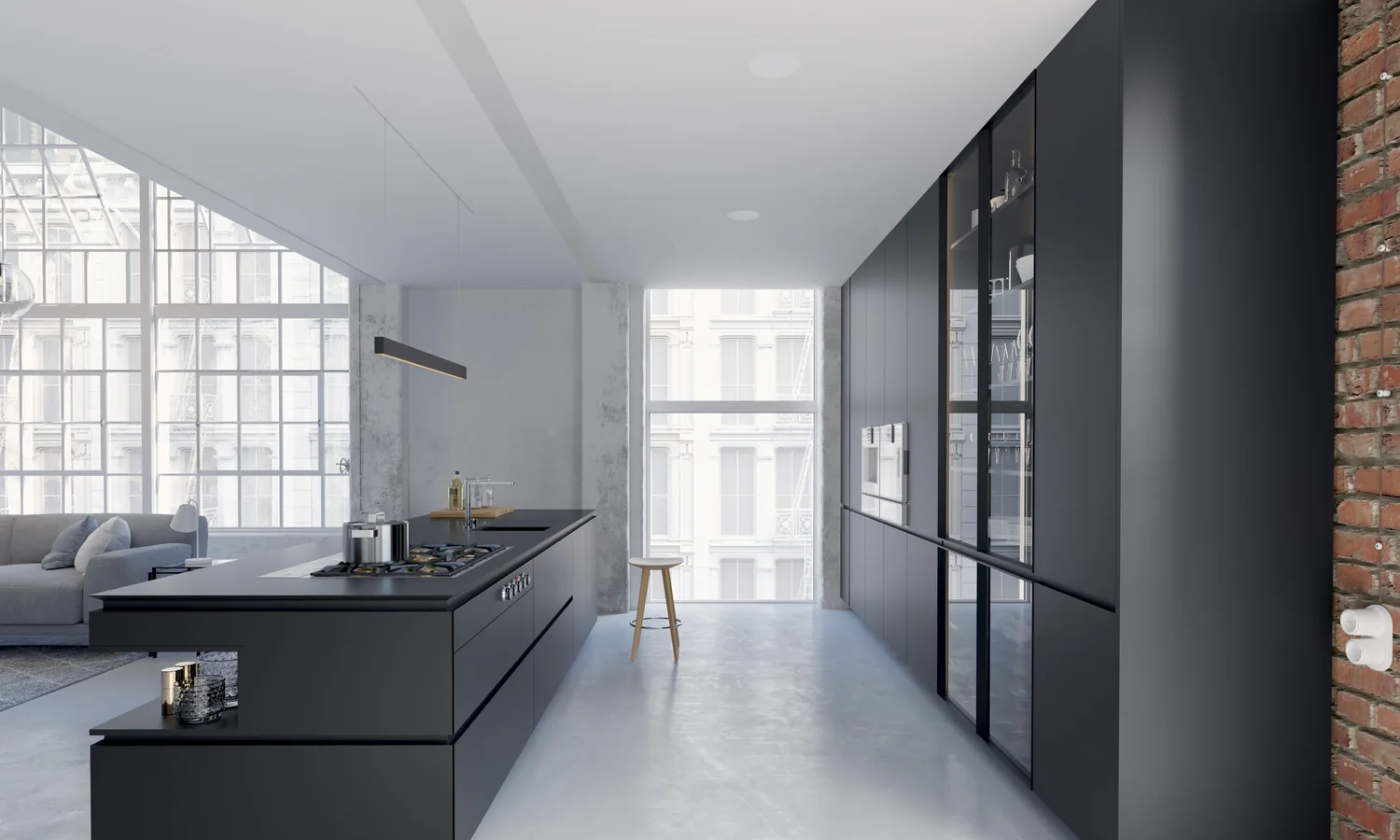
Uni-Q is a coaxial driver: the tweeter sits in the throat of the midrange cone, so the two behave like one source. Conventional speakers put them an inch or two apart, which is fine directly in front and wrong everywhere else. In a living room, where nobody sits in the one right chair, a single apparent source is the difference between speakers you notice and music you do not.
The current twelfth-generation Uni-Q adds Metamaterial Absorption Technology — MAT — a maze-like disc behind the tweeter that absorbs nearly all of the sound that would otherwise bounce back through the dome. KEF's figure is 99 percent. The audible result is treble that is cleaner and less tiring, and it is now in everything from the Reference towers to the in-ceiling speakers we put above a kitchen island.
The client asked where the speakers were. They were looking straight at them.— Blue Note A/V
Ci SeriesIn the Ceiling, in the Wall
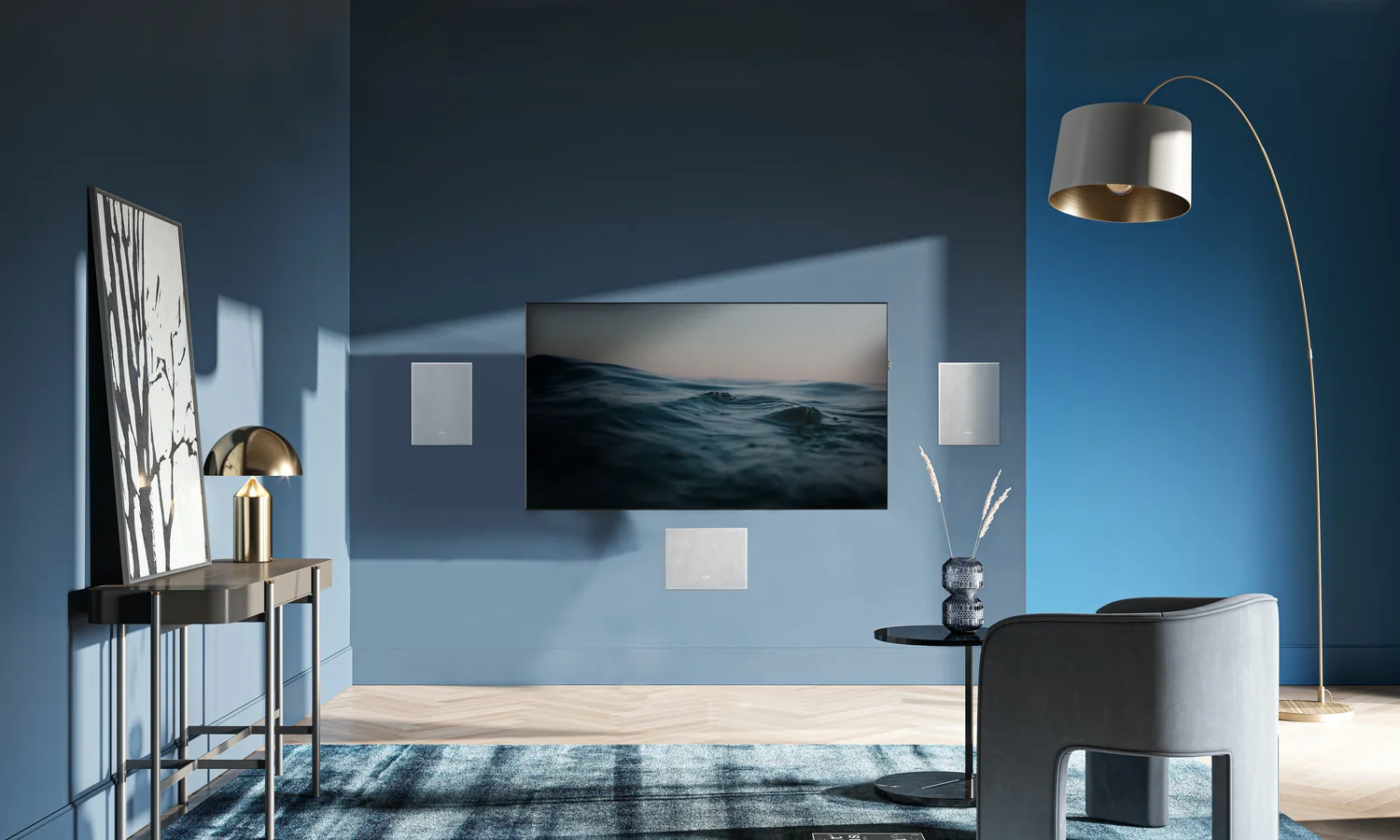
Ci is KEF's custom-installation range, and it is where the Uni-Q idea earns its keep, because an in-ceiling speaker is by definition never aimed at you. The range runs in tiers: E and Q for rooms that want good sound at a sensible cost, C and T for tighter budgets and shallow walls, and R at the top — the same Uni-Q and MAT as the hi-fi speakers, in a round or rectangular frame. The THX Certified models at the top of the R line carry Ultra and Dominus ratings, which means an in-wall speaker that will hold its own as the front channel of a serious theater.
What we like, beyond the sound, is the hardware. Magnetic grilles that sit flush and take paint, tone-matched drivers behind them so nothing shows through, and mounting that a finished ceiling can live with for twenty years. For bass, KEF's Kube in-room subwoofers and the Ci installed subs finish the job without a box in the corner.
LS WirelessThe Ones You Can See
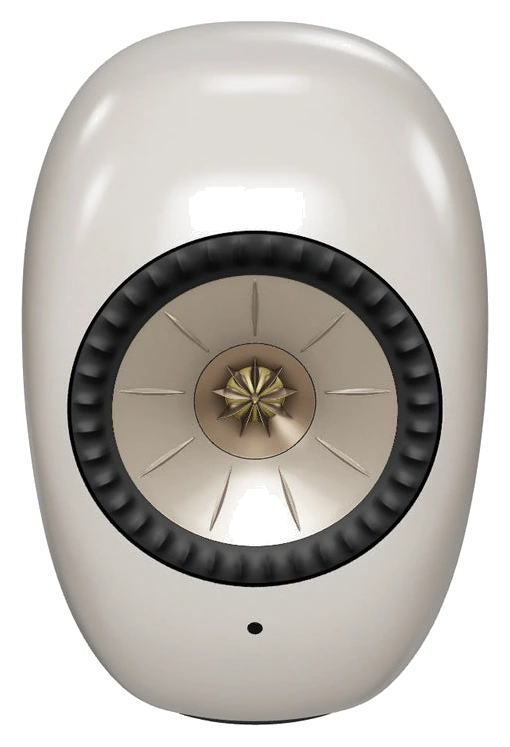
Not every room wants its speakers hidden. The LS wireless family is KEF's answer for the shelf and the console: LSX II and LSX II LT for a desk or bedroom, LS50 Wireless II as the one most people should hear first, and LS60 Wireless, a slim active floorstander that replaces a rack of separates with two cabinets and a power cord. Each is a complete system — amplification, streaming, room correction — with the same Uni-Q up front.
We have written about two of them at length: the LS Luxe, which is the LS50 idea sculpted for a finer room, and the XIO, the first KEF soundbar and the rare one we recommend without a caveat. Both tie into the whole-house system, so the shelf speaker in the study is a zone like any other.
Reference and BladeThe Top of the Tree
Above all of it sit Reference and Blade, the speakers the rest of the range is tuned to resemble. Blade is the sculptural one — a single Uni-Q on the face and four bass drivers firing sideways in pairs, so the whole cabinet behaves like one point in space. Reference is the conventional-looking one, built to a standard rather than a price. Neither is a whole-house speaker. Both are what a dedicated two-channel room is for, and we set them up by measurement like anything else we sell.
OutdoorNew This Month, and Overdue

KEF has made a weatherproof surface-mount speaker for years — the Ventura 5 and 6, rated to IP65. In September 2026 it finally built a proper landscape line around a weatherproof Uni-Q: SR4Q and SR6Q satellites on stakes, BH6Q and BH8Q bollards, BL8b and BL12b bollard subwoofers, and the BQ9 and BQ11 three-way bollards for larger properties. IP66 sealing, UV-stable finishes, salt-spray tested for more than 500 hours, rated from −13°F to 158°F — which is to say, rated for a Dallas August.
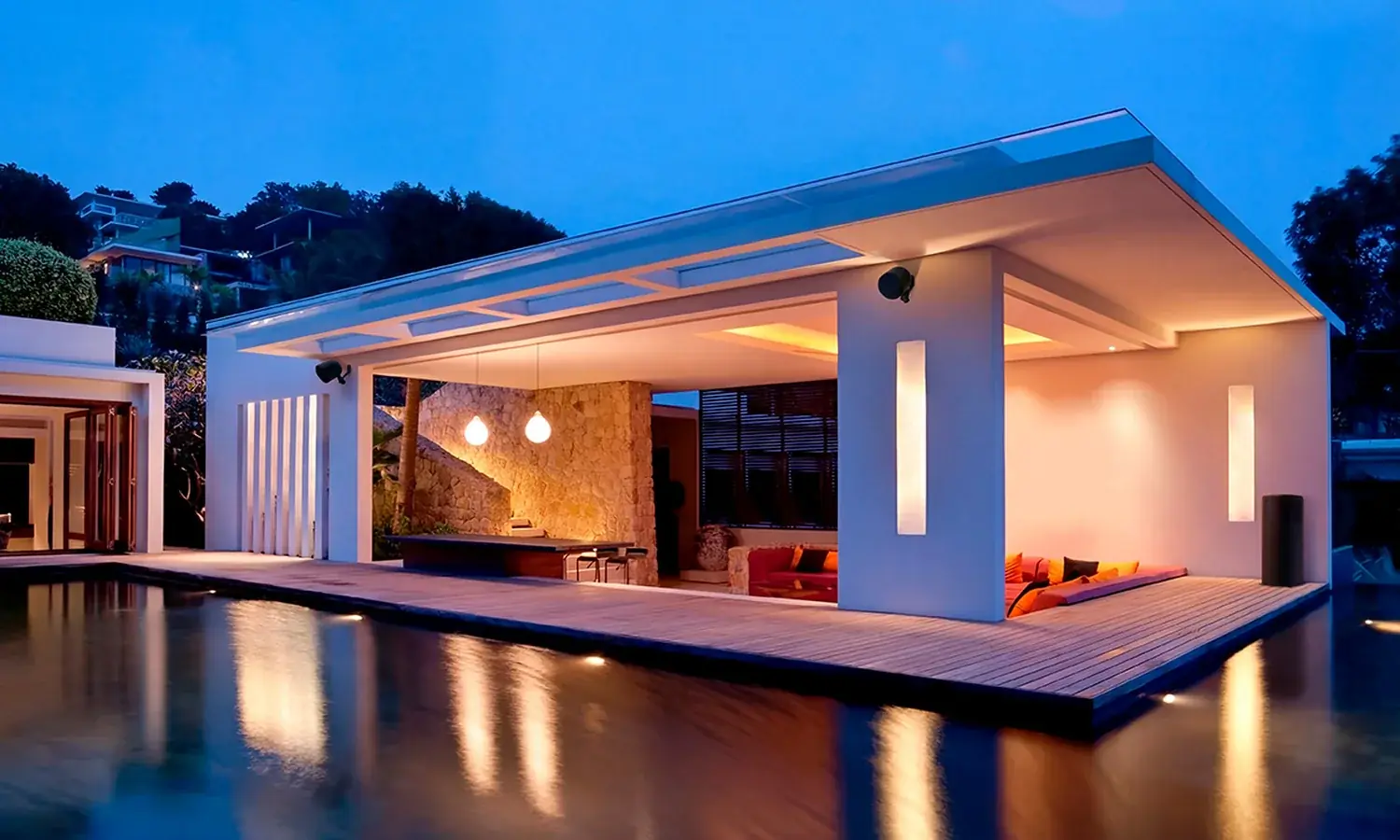
Alongside the speakers came KASA, a family of network DSP amplifiers built to drive them: multi-zone, matrixed, configured from a browser and controlled over IP, so the garden becomes zones on the same keypad as the kitchen. It is the piece the outdoor category has been missing from a hi-fi maker, and it is why KEF now sits in the Outdoor group on our brand wall as well as under Loudspeakers.
At a GlanceThe KEF Range as We Install It
| Line | What It Is | Where It Belongs |
|---|---|---|
| Ci R / THX | Flagship in-ceiling and in-wall, Uni-Q with MAT | Media rooms, theaters, the rooms that matter most |
| Ci E / Q / C / T | Architectural, tiered by budget and depth | Kitchens, bedrooms, halls — the rest of the house |
| Kube / Ci subwoofers | In-room and installed bass | Under the music, out of sight |
| LSX II / LS50 W II / LS60 W | Complete wireless systems | The shelf, the study, the console |
| LS Luxe / XIO | Wireless dressed for the living room; Atmos soundbar | Rooms where the speaker is allowed to show |
| Reference / Blade | The top of the range | A dedicated two-channel room |
| Landscape / Ventura / KASA | Satellites, bollards, buried subs, surface-mounts, and the amplifiers that drive them | The part of the house without a roof |
The Real WorldWho It's For
KEF is for the house that wants to sound like one house. The same driver idea in the ceiling, on the shelf and in the planting means a family walking from the kitchen to the patio hears one system, not three. It scales honestly: the Ci E and Q lines make whole-house audio affordable without sounding like ceiling speakers, the R line and the LS wireless family are where most of our clients land, and Reference and Blade are there for the one room built around listening. Like every architectural speaker, the Ci range sounds like the ceiling it is in; placement against the reflected ceiling plan and a proper setup are most of the result, which is the part we do.
Why KEF
- Uni-Q: the sweet spot is the whole room
- The same technology from the reference towers down to the in-ceiling speakers
- An architectural range with real tiers, not one compromise
- Paintable grilles and tone-matched drivers that disappear
- A complete outdoor line and the amplifiers to run it, new in 2026
Things to know
- The outdoor line is brand new; we will report back after a Texas summer
- Architectural speakers live or die on placement — plan them in the drawings
- Reference and Blade want a room and electronics to match
The brand we reach for when the whole house has to agree
Plenty of companies make a fine in-ceiling speaker, or a fine wireless speaker, or a fine outdoor speaker. KEF makes all three on one idea, and the idea is the right one for a house where nobody sits in the perfect chair. It hides when you want it to and stands up when you don't, and it sounds like itself in every room.
Best for: Whole-house audio that is heard and not seen, media rooms with nothing on the floor, and now the garden.
Hear Uni-Q in a treated room
Book a private audition at our Farmers Branch showroom. Bring a playlist. Sit wherever you like — that is the point.
Book an Audition